




Underfloor heating is usually a good fit when a floor is being taken up anyway, such as during an extension, a kitchen refit or a full renovation, and when the room has reasonable insulation. It’s a harder sell as a retrofit in a single room of an older, draughty house, where the disruption and raised floor levels can outweigh the benefits. We cover homes right across North Somerset, including Yatton and Long Ashton.
It gives an even, gentle warmth, frees up wall space and works well with modern condensing boilers and heat pumps. The trade-off is that it’s slower to warm up than radiators, and it’s more involved to install. Whether it’s right for you depends on the room, the floor and what’s happening to the house.
If you’re weighing it up for a project, our underfloor heating page explains how we approach it.
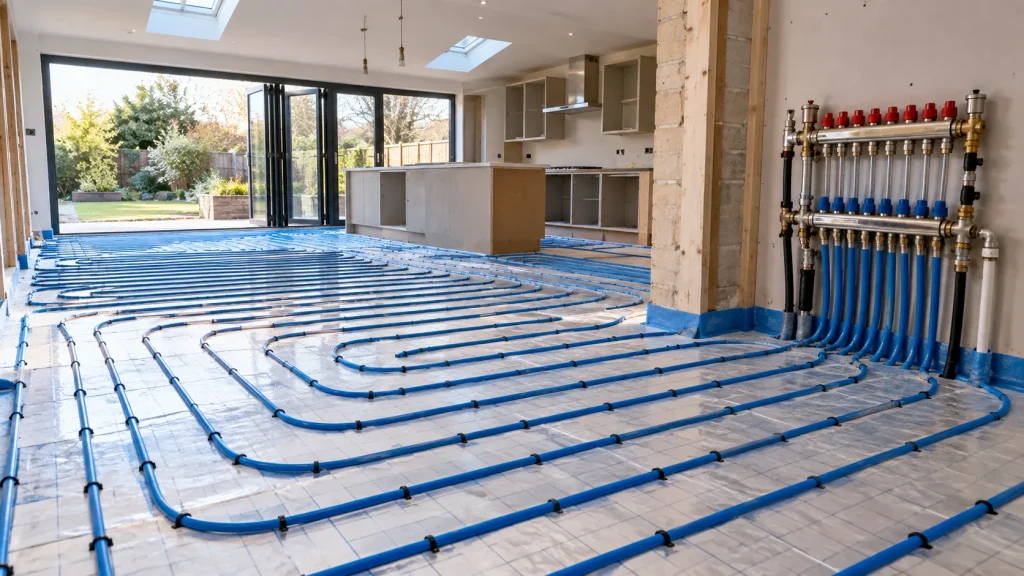
Wet or electric: the first decision
There are two main types, and they suit very different jobs.
| Wet (water-based) | Electric | |
|---|---|---|
| How it works | Warm water from the boiler or heat pump runs through pipes in the floor | Heating mats or cables under the floor finish |
| Best for | Whole floors, extensions, new builds, larger rooms | Bathrooms, small rooms, single-room refurbishments |
| Installation | More involved; needs floor build-up, manifold and controls | Simpler and thinner; often fitted under tiles |
| Running costs | Usually lower, especially on large areas | Usually higher, as it runs on electricity at standard rates |
As a rough rule, wet systems make sense where you’re heating a larger area over long periods. Electric mats are handy for taking the chill off a bathroom floor, but they’re rarely the cheapest way to heat a whole room day in, day out.
Which rooms and homes suit underfloor heating best
It tends to work best in:
- Extensions and open-plan kitchen-diners, where large glazed areas leave little wall space for radiators.
- Ground floors with a solid concrete slab, where pipes can be laid in a screed during building work.
- Bathrooms and en-suites, where a warm floor is noticeably more comfortable.
- Well-insulated rooms, because underfloor heating runs at lower temperatures and relies on the room holding its heat.
It’s more challenging in older properties with suspended timber floors and limited insulation, which are common in parts of North Somerset’s period housing. It can still be done, using low-profile or between-joist systems, but the design needs care and the room may still need some help from a radiator in very cold spells.
How it works with your boiler or heat pump
A wet system runs at a lower water temperature than radiators. A mixing valve and pump at the manifold blend the water down to the right temperature before it goes into the floor.
That lower temperature suits condensing boilers, which work more efficiently when the returning water is cooler. It’s also why underfloor heating pairs so well with heat pumps. If you have radiators upstairs and underfloor heating downstairs, the system needs to be designed so both get the right temperature, which is a job for a heating engineer rather than something to guess at.
Controls matter too. Each zone normally has its own thermostat, and good smart heating controls make it easier to run the floor on steady, efficient settings rather than blasting it on and off.
Floor coverings: what works and what doesn’t
The floor finish acts as a layer between the heat and the room, so it affects how well the system performs.
- Stone and ceramic tiles conduct heat well and are the most forgiving choice.
- Engineered wood and laminate generally work, but check the manufacturer confirms it’s suitable for underfloor heating and note any maximum surface temperature.
- Vinyl and LVT usually work if the product is rated for it.
- Thick carpet and heavy underlay slow heat transfer noticeably. Use a low-tog underlay if carpet is planned.
The practical downsides to weigh up
Underfloor heating isn’t a straight swap for radiators. Things to consider:
- Slower response. A screeded floor can take hours to warm up, so it’s usually run on longer, steadier periods rather than short bursts.
- Floor height. Overlay systems raise the floor slightly, which can affect door thresholds and kitchen plinths.
- Disruption. Screeded systems need the floor up and time for the screed to dry.
- Access for repairs. Pipes are buried, so good installation and pressure testing at the start matter.
Planning underfloor heating in North Somerset
Many projects around Portishead, Clevedon and Nailsea are kitchen extensions or open-plan conversions, and that’s usually the ideal time to plan underfloor heating. Talk to your builder and heating engineer early, before the floor is laid, so insulation levels, screed depth and pipe layout can all be agreed. It’s far easier than trying to add it once the floor is finished.
It’s also a good moment to check the rest of the central heating system can support the extra zone.
Frequently asked questions
Can underfloor heating replace radiators completely?
In a well-insulated room or new build, often yes. In older, draughtier rooms, it may need a radiator for back-up in very cold weather. A heat loss calculation for the room shows whether the floor alone can cope.
Can I run underfloor heating from a combi boiler?
Usually, yes. A wet system connects to the boiler through a manifold with its own pump and mixing valve. The boiler needs enough output for the extra area, which your engineer should check during the design.
Is electric underfloor heating expensive to run?
It depends on the size of the area and how long it runs. For a small bathroom used for short periods, costs are generally modest. For heating a large room all day, a wet system is usually cheaper to run.
Does underfloor heating need servicing?
Wet systems benefit from the same care as the rest of the heating: the boiler serviced annually and the system water kept clean with inhibitor. The manifold and controls can be checked at the same time.
Talk it through before you build
If you’re planning an extension or renovation and aren’t sure whether underfloor heating is worth it, give us a call on 01275 846 437 or send us a message. We’re happy to come and have a look at the room with you.