



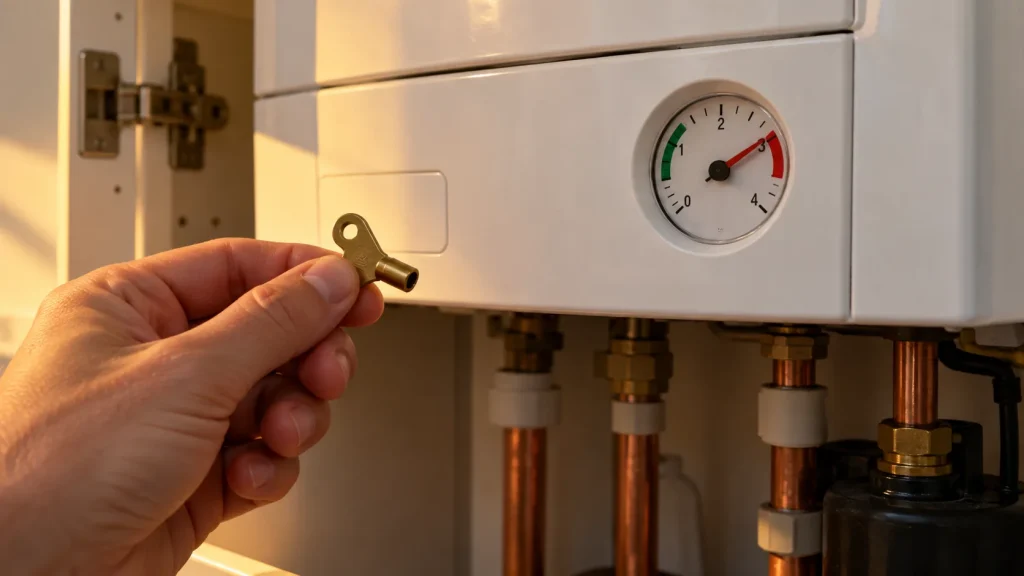
Most people worry about boiler pressure dropping, but it can climb too high as well. If the needle on your gauge is well into the red, or water is dripping from a small pipe outside, the pressure may be too high. The usual causes are a filling loop left open, too much water added when topping up, or a problem with the expansion vessel. You can often bring it down by bleeding a radiator, but if it keeps rising, a boiler repair visit is the next step. August is a good time to check, before the heating comes back on. We cover homes right across North Somerset, including Yatton and Long Ashton.
What’s a normal boiler pressure?
On most combi and system boilers, the pressure should read around 1 to 1.5 bar when the heating is off and cold. It’s normal for it to rise a little when the heating is running, as the water expands when it heats up. Many gauges have a green zone showing the normal range. Check your manual for your boiler.
If the pressure is near 3 bar, it’s too high.
What happens if it gets too high?
Boilers have a pressure relief valve as a safety device. If the pressure gets too high, the valve opens and lets water out through a pipe, usually a copper pipe that runs outside the house. You may notice it dripping or wet marks on the wall below it. The boiler may also lock out and show a fault code.
Common causes
Filling loop left open
The filling loop is the flexible hose or key used to top up the pressure. If it’s left open, or the valve doesn’t close fully, mains water keeps creeping into the system and the pressure rises.
Too much water added
It’s easy to overfill when topping up. If the pressure was set high when the system was cold, it will climb further once the heating comes on.
Expansion vessel problems
The expansion vessel is a tank inside or near the boiler that absorbs the extra volume as the water heats up. If it loses its air charge, there’s nowhere for the expanding water to go, so the pressure jumps when the heating runs. This needs a Gas Safe registered engineer to check and recharge, or replace, the vessel.
How to bring the pressure down
- Turn the heating off and let the system cool.
- Check the filling loop is fully closed.
- Bleed a radiator. Use a radiator key to open the bleed valve, with a cloth underneath to catch water. Let some water out, keeping an eye on the gauge, then close the valve once the pressure is back in the normal range. Our step-by-step guide on how to bleed a radiator explains this in more detail.
- Check the pressure again once the heating has run for a while.
Never remove the boiler casing or try to adjust parts inside it yourself.
When to call an engineer
Call a Gas Safe engineer if:
- The pressure keeps rising after you’ve closed the filling loop and bled a radiator
- The pressure shoots up every time the heating comes on
- Water keeps coming out of the pressure relief pipe
- The boiler keeps locking out with a pressure fault
Getting ready for winter in North Somerset
The heating is often off for months over the summer in homes around Nailsea, Portishead and Clevedon, so problems can go unnoticed until the first cold evening. A quick look at the pressure gauge in late summer, and booking your boiler service before the autumn rush, means any faults are found before you need the heating.
Frequently asked questions
Is 3 bar too high for a boiler?
Yes. On most domestic boilers, 3 bar is the point at which the pressure relief valve is designed to open. Normal pressure is usually around 1 to 1.5 bar when the system is cold. Check your boiler manual for its recommended range.
Why does my boiler pressure go up when the heating is on?
A small rise is normal, as water expands when it heats up. A big jump usually points to a problem with the expansion vessel, which absorbs that extra volume. If the pressure rises sharply every time the heating runs, ask an engineer to check the vessel.
Can high boiler pressure be dangerous?
Boilers have safety devices, including a pressure relief valve, to stop the pressure getting dangerously high. Even so, high pressure puts strain on the system and can cause leaks or lockouts. If it keeps happening, get it checked by a Gas Safe registered engineer.
Boiler pressure still high?
If you’ve bled a radiator and the pressure keeps climbing, give us a call on 01275 846 437 or drop us a message and we’ll find the cause and get it sorted.